Extracurricular

How to get Published in a High School Research Journal

IMRaD structure, reviewer responses, and realistic publication timelines

How to Get Published in a High School Research Journal
Published:

Fareen S

Researcher and education writer

Summary

To get published in a high school research journal, you need three things: a tightly scoped research question, a method that can be clearly replicated, and a manuscript structured in standard IMRaD format (Introduction, Methods, Results, Discussion). Most successful submissions go through 1-3 rounds of revision, and clarity determines acceptance far more than complexity does. This guide covers how to pick a publishable project, how to structure each IMRaD section, how to respond to reviewer comments, and what to do with a rejection or a null result.

Before you write: pick a publishable project

The most common mistake students make is trying to answer a question that is too large. High school journals are not evaluating whether your research is ground breaking at a global scale. They are evaluating whether it is methodologically sound, logically structured, and honestly reported.

Why small, rigorous projects get published (and ambitious ones don't)

A tightly designed study, such as testing how caffeine affects reaction time in 30 students, has a far higher chance of publication than a vague, overreaching project attempting to analyze global socioeconomic trends.
A simple test of publishability
Can you clearly explain what you measured, how you measured it, and what you found? If not, the project is not ready, and specificity is what makes it publishable.
Too broad
Publishable
"I want to research climate change."
"Does variation in urban tree cover correlate with reported anxiety scores among high school students in my city?"

Feasible datasets and replicable methods

Your methods must be something a student at another school could, in theory, replicate using similar tools. That rules out methods depending on equipment only accessible at a university lab you visited once. It also means being honest about your sample size: a sample of eight is not disqualifying, but it changes what claims you can make.
Before committing, ask four questions.
• Can I collect this data myself or reliably access it?
• Can I learn and apply the analysis methods required?
• Is my timeline realistic, including revisions?
• Can I work independently, even with mentor guidance?
If your answer to that last question is "mostly dependent," make sure your mentor is genuinely committed, because a paper co-authored with a research mentor who goes quiet for three months mid-revision is a paper that doesn't get published. Crimson's research mentorship builds that commitment in with structured milestones through the revision cycle, which is where most student papers stall.

Research ethics: consent, attribution, and AI disclosure

If your research involves human subjects, you must obtain informed consent, clearly explain how data will be used, and confirm participation is voluntary and informed. Some journals also require an ethics statement.
Every idea, dataset, and reference must be properly cited. Use citation management from day one; Zotero is free and works well.
If you used AI for drafting, editing, or ideation, disclose it transparently. Journals increasingly expect this, and non-disclosure risks immediate rejection.

How to structure a high school research paper (IMRaD format)

IMRaD (Introduction, Methods, Results, and Discussion) is the skeleton of nearly every scientific paper you'll read or write. Each section exists because it answers a specific question a reader has.

Abstract

What does your study show, in 150-250 words?

Introduction

What question are you answering, and why does it matter?

Methods

How could someone replicate your study exactly?

Results

What did you find, reported without interpretation?

Discussion

What do the results mean, and what are the limits?

Abstract: what does your study show?

The abstract summarizes your entire study in 150-250 words and should answer four things:
• What the question was
• What you did
• What you found
• Why it matters
The most common problem students face with the abstract is vagueness
"This study examined the relationship between sleep and academic performance in high school students"
This tells a reviewer almost nothing. A better version names the sample, the measurement tools, the key finding, and the implication.
Tip
Write one sentence for each IMRaD section, then connect them. You'll have a functional draft abstract in ten minutes.

Introduction: what question are you answering?

The Introduction explains why your research question matters, what gap it fills, and closes with a clear statement of your research question or hypothesis.
Most student introductions are either too broad ("sleep is important for teenagers") or skip straight to the hypothesis without establishing why it matters.
A strong introduction cites eight to ten sources that map what's already known, then shows precisely where your study fits.
A strong introduction covers
• The broader scientific or social context
• What existing research has established
• What remains unknown or contested
• Your specific research question or hypothesis

Methods: how can someone replicate your study?

The Methods section provides enough detail for another researcher to reproduce your study exactly. It must include:
• The exact instrument, software version, or survey scale you used
• How participants were recruited, screened, and assigned to conditions
• Your analysis procedure, described step by step
• Acknowledged limitations in your methodology
A small replication test
Hand your methods section to someone who wasn't involved. If they have more than two questions about how to reproduce the study, revise.

Results: what did you find?

The Results section reports your findings objectively, without interpretation. Every key finding should be supported by data, and every figure or table must be referenced in the text. Results should contain descriptive statistics for your sample and key variables, the outcomes of each analysis with exact values, and figures and tables with properly labeled axes, units, and captions.
Good vs Bad results statements
A clean Results statement looks like this: "Participants in Group A showed a mean reaction time of 312ms (SD = 42ms), compared to 278ms (SD = 38ms) in Group B (p = 0.03)."
Avoid any sentences that starts with "this suggests," "this may indicate," or "this supports the hypothesis that."
Those sentences belong in the Discussion.

Discussion: what do the results mean?

The Discussion interprets your findings, connects them to existing research, and acknowledges limitations. A strong Discussion interprets each key result in relation to your hypothesis, connects findings to sources cited in your Introduction, honestly addresses limitations such as sample size, measurement constraints, and alternative explanations, and suggests specific, feasible directions for follow-up research.
Avoid overclaiming
If your results support a correlation, do not claim causation; reviewers flag this consistently.
Aim for the register of this example: "The faster reaction times observed in Group B may reflect the hypothesized effect of caffeine on dopamine pathways, though the effect size (Cohen's d = 0.87) suggests other variables may contribute."

The boundary between the two hardest sections is simple: Results describe, Discussion interprets. Any sentence beginning “this suggests” belongs in the Discussion.

Use JEI-style expectations as a reference model

The Journal of Emerging Investigators is one of the most accessible peer-reviewed journals for high school and early undergraduate researchers, and its guidelines are a useful reference even if you're submitting elsewhere.
JEI publishes work in biology, chemistry, physics, environmental science, and social and behavioral science. Its reviewers are graduate students and postdocs trained to give developmental feedback, and it expects original primary research rather than reviews of existing literature or science fair recaps. JEI has published over 500 papers from young scientists, including middle and high school students.
The process in practice: you submit through an adult, the manuscript goes to an editor for a desk check on scope, formatting, and basic rigor, then to multiple reviewers for peer review. The decision is typically "major revisions," "minor revisions," or "reject," and you can expect several rounds of revisions.
Major revisions does not mean your paper is bad. It means the reviewers think it's worth salvaging and they're giving you a roadmap.

The full timeline from project to publication

Time Period
Phase
2-6 months
Research
2-4 weeks
Writing the manuscript
4-12 weeks
Peer review
1-3 months/round
Revisions (1-3 rounds)
Students aiming to include a publication in college applications should begin by early junior year. The companion guide on choosing a research journal covers the deadline math in detail.

How to respond to peer review comments

Getting reviewer comments back can feel like a gut punch, especially the first time. A page of specific criticism on work you spent months doing is hard to read neutrally. Read the comments once and walk away for a day, then come back and read them as instructions rather than judgments.
Use this structure for every response
1. Quote the reviewer's comment
2. Acknowledge the issue
3. Explain what you changed
4. Show exactly where the change was made For example, to the comment "Methods lack detail on participant selection" a clean response is: "We have clarified recruitment criteria and added details in Section 2.1."

Common triggers for major revisions

Based on patterns in high school journal submissions, the most common reasons for major revision requests are:
• A research question that is too broad or vague
• Methods not detailed enough to replicate
• A small sample size that is not acknowledged as a limitation
• Results and Discussion mixed together
• Claims that go beyond what the data supports
• Figures lacking labels, captions, or statistical context
• Too few academic sources in the Introduction

How to handle negative or null results

Null results, such as finding no significant relationship or no meaningful difference, are publishable, and they're undervalued in science. If your methods were sound and your question was reasonable, a null result is a real contribution. Null results often carry more credibility with experienced reviewers and admissions readers because they signal restraint, honesty, and real scientific reasoning.
In your Discussion, frame the null result as a finding: "The absence of a significant correlation between X and Y suggests that [interpretation]. Future research with larger samples or alternative measures of Y might clarify whether this finding reflects a genuine null or a power limitation."
Avoid manipulating analyses to force significance. This is easily detected and damages credibility.
A null result is not a failed project
If your methods were sound and your question was reasonable, finding no effect is a real contribution. Null results signal restraint and honest scientific reasoning, which experienced reviewers and admissions readers rate more highly than a suspiciously tidy positive finding.

Authorship and contribution statements

If your paper has multiple authors, such as you, a classmate, and a mentor, every journal will require a contribution statement. This section carries more credibility weight than its length suggests: it's one of the things that separates getting published from looking like you did.
Weak statement
Strong statement
"All authors contributed equally to this work."
"J.R. designed the study protocol, recruited participants, and conducted all data collection. M.S. performed statistical analysis and created figures. Dr. K.A. supervised experimental design, reviewed all drafts, and provided laboratory resources. All authors reviewed and approved the final manuscript."
The weak version raises immediate flags for reviewers and admissions readers. Research doesn't work that way: contribution is always unequal, and pretending otherwise reads as either naive or evasive. If you are the sole student author and your mentor contributed primarily through supervision and review, say exactly that.

What a believable contribution statement sounds like to admissions readers

Admissions officers and scholarship reviewers who evaluate research claims are sophisticated readers. A contribution statement that rings true is one where the student's role is specific and bounded rather than omnipresent:
"I designed the survey instrument, administered it to 45 participants, and ran the regression analysis in R. My mentor reviewed my analysis plan and suggested the inclusion of a control variable I had not initially considered."
That second sentence, acknowledging a mentor's substantive contribution, increases credibility rather than diminishing it. It shows the student understands how research actually works, and it pre-empts the reviewer's skepticism about whether a high schooler really ran the whole thing alone.

How publication attempts play out: two cases

Case A: Published after two revision rounds

[Redacted], a junior in Ontario, submitted a behavioral study on phone use and sleep quality in a sample of 45 students to a peer-reviewed high school journal in September of her junior year. Her first decision, six weeks later, was major revisions: unclear methods, overclaiming, and incomplete figures. She revised over three weeks and resubmitted. Minor revisions followed, which she completed within a week, and acceptance came in late January of her junior year.

By the time she was writing colle

Case B: Rejected, then reframed as a conference poster

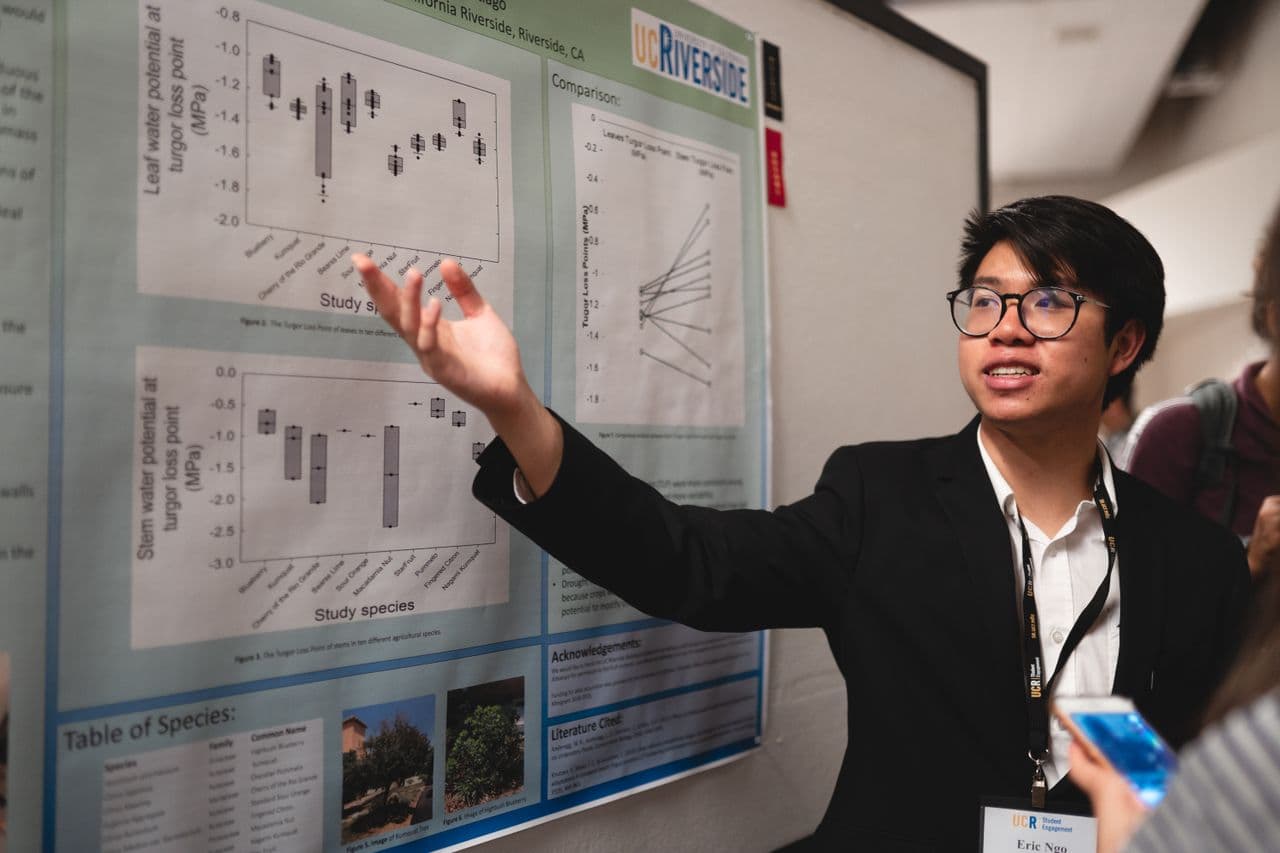
[Redacted] conducted an environmental chemistry study on microplastics in local waterways. Her paper was rejected for small sample size, weak validation, and underpowered analysis. Instead of abandoning the project, she reframed it as a conference poster and presented it at a regional symposium.

The poster became something she could talk about substantively: the methodology she used, what the findings suggested, and what a better-designed follow-up study would look like. For a student interested

What a research mentor needs to see before co-authoring

Mentors apply their own bar before putting their name on a student paper, and it is stricter than most students expect. The test is whether the student owns the process, and it applies well beyond the paper: it is the same test an admissions interviewer applies when they ask about your research.

Can this student explain, out loud, without notes, exactly what they did and why? If they can walk me through the study design, defend the analytical choices, and identify the limitations themselves, I'm confident enough to put my name on it.

Fareen S

Research Writer at Indigo Research

Submission checklist

Before submitting, confirm:
• Your research question is specific, testable, and realistically scoped
• Your methods can be replicated without additional explanation
• Results and Discussion are fully separated
• All claims are proportional to your data
• Limitations are explicitly acknowledged
• Figures are labeled, captioned, and referenced in the text

Book a free consultation with one of our expert advisors.