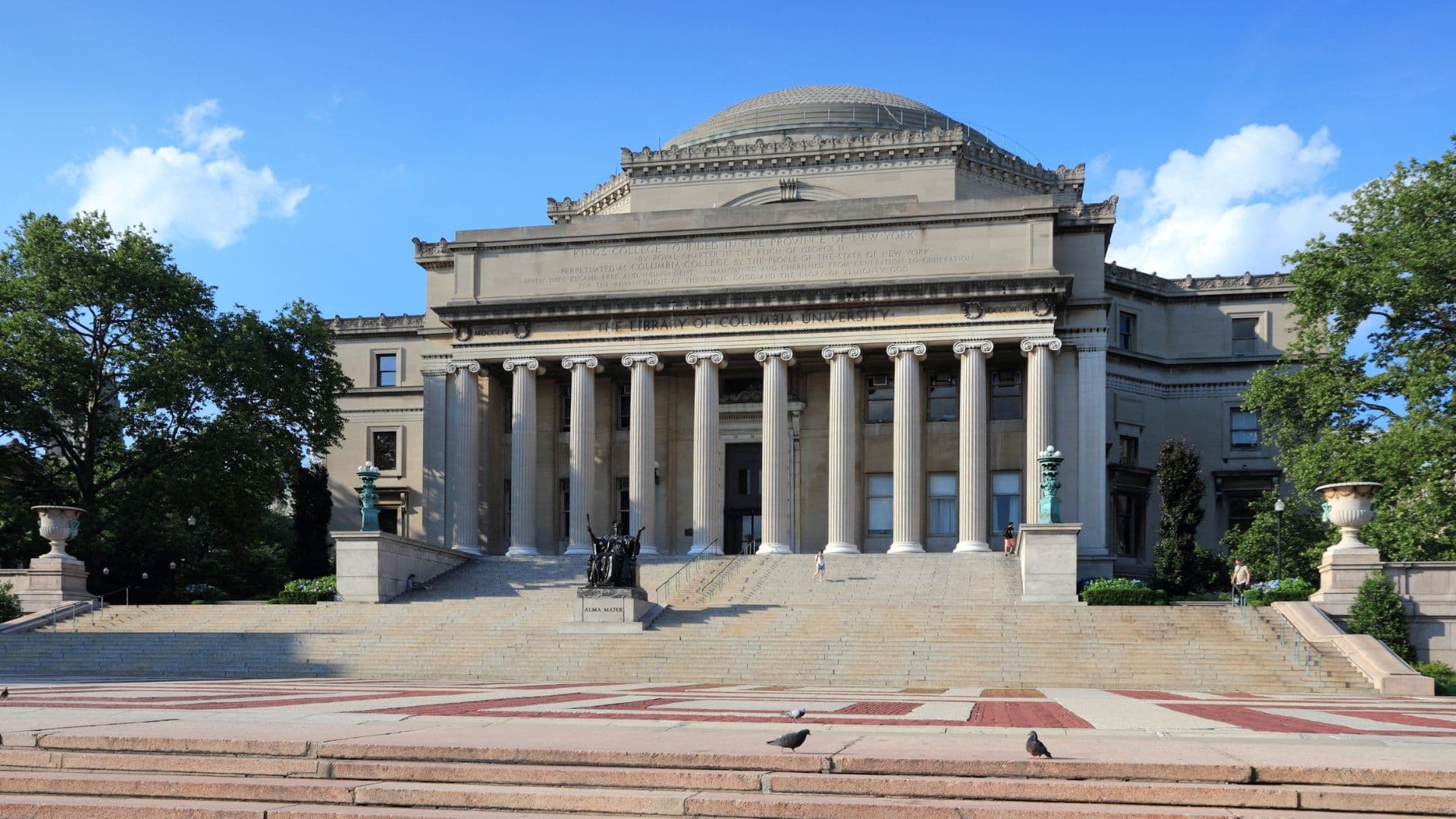
The Ivy League is a group of eight private universities in the northeastern US: Brown, Columbia, Cornell, Dartmouth, Harvard, Penn, Princeton, and Yale. The name comes from a 1954 athletic conference, but it now doubles as shorthand for the most selective tier of American admissions, with Class of 2030 acceptance rates running from about 4% to 8%.
What are the Ivy League schools?
The Ivy League is a group of eight private research universities in the northeastern United States: Brown, Columbia, Cornell, Dartmouth, Harvard, the University of Pennsylvania, Princeton, and Yale.
The Ivy League began with sport. Sportswriters started using the term in the 1930s, the athletic conference was formally organized in 1954, and league competition began in 1956. Its academic prestige developed later as the eight universities became associated with extraordinary selectivity, resources, and graduate outcomes. Conference membership also explains why Stanford, MIT, and Duke sit outside the Ivy League despite being equally selective.
The eight Ivies share centuries of history, single-digit acceptance rates, large endowments, need-blind admission for US citizens and permanent residents applying as first-year students, and alumni networks that operate globally. Seven were founded before 1770, while Cornell arrived in 1865. For your college list, their differences matter just as much as those shared strengths, because each offers its own curriculum, scale, culture, and admissions priorities.
School
Location
Founded
Class of 2030 acceptance rate
Brown University
Providence, RI
1764
5.3%
Columbia University
New York, NY
1754
4.2%
Cornell University
Ithaca, NY
1865
est. 8–9%*
Dartmouth College
Hanover, NH
1769
5.8%
Harvard University
Cambridge, MA
1636
est. 3.8–4.4%*
University of Pennsylvania
Philadelphia, PA
1740
5.8%
Princeton University
Princeton, NJ
1746
est. 4.2–4.6%*
Yale University
New Haven, CT
1701
4.2%
*Harvard, Princeton, and Cornell withhold full Class of 2030 figures until federal reporting in fall 2026. Ranges are estimated from confirmed admit counts and recent cycles.
How hard is it to get into an Ivy League school in 2026?
For the Class of 2030, Yale and Columbia admitted 4.2% of applicants, or roughly one in 24. Cornell’s estimated 8% to 9% rate was the highest in the league, and even there, around 11 or 12 students competed for each place. Penn admitted 5.8% of 61,264 applicants after applications fell 15% following the return of required testing. Harvard and Princeton will release their full figures through federal reporting in the fall.
The ten-year trend is even more revealing. Yale’s pool grew from 31,455 applications for the Class of 2020 to 54,919 for the Class of 2030, an increase of about 75%, while its admit count grew by 17%. Similar pressure has built across the league as application volumes have risen much faster than class sizes.
I see the consequences every March. Exceptional students are competing with thousands of applicants who have achieved at a similar level, so academic strength earns serious consideration while intellectual direction, contribution, and school-specific fit create distinction. I’d focus on the universities where your profile gives the committee the clearest reason to advocate for you.
The Ivy League is eight schools solving eight different puzzles. The students who get in understand which puzzle they're applying to. The students who get rejected apply to a brand.
Jamie Beaton
CEO & Co-Founder
The Ivy League schools
Parents often ask me which is the best Ivy League for their child, but there is no single best school. All the Ivies share extraordinary resources and global recognition, but each rewards different intellectual styles and offers a very different undergraduate life.
I’d evaluate each one by asking three straightforward questions: How do you want to learn? What do you want to build? And what kind of community will help you perform at your best?
At 17, your answers will naturally keep evolving, and even an early sense of direction can sharpen your school list and make each application more persuasive.
Brown’s Open Curriculum removes general education and distribution requirements, giving you unusual freedom to shape your degree. It suits students who are curious, self-directed, and comfortable crossing academic boundaries, while Brown’s warm, collaborative, and slightly unconventional culture rewards people who pay attention to those around them.
Your application should show how you’d use that flexibility with purpose, including through PLME, the Ivy League’s only combined baccalaureate-MD program and an eight-year continuum at Brown, or the Brown-RISD dual degree if either path fits your interests.
Columbia combines Manhattan with the most structured shared curriculum in the Ivy League. Through the Core Curriculum, students discuss foundational works in literature, philosophy, art, music, and science before carrying those conversations into their majors and the city. It suits intellectually curious students who enjoy real debate and want both strong academic traditions and a wider urban community.
Your application should explain why this particular combination fits the way you think and the education you want, with details that reach beyond New York and Columbia’s name.
Do they love Columbia? Are they showing that they would truly enjoy being a student here and see themselves having a place in this academic village, this academic community?
Cornell is the league’s only land-grant university and its largest, with roughly 16,000 undergraduates. You apply directly to one of its colleges, which range from Engineering and Arts & Sciences to Agriculture and Life Sciences, Industrial and Labor Relations, and the Cornell SC Johnson College of Business, home to the Nolan School of Hotel Administration. Three undergraduate colleges are state-supported and offer reduced tuition to New York residents.
Strong applications explain why this college, program, and field. Cornell suits students with defined interests, from computer science and architecture to labor relations and viticulture, who also want access to a much wider university.
Dartmouth is the smallest Ivy and one of the most intensely residential, with its rural Hanover setting, undergraduate focus, and flexible D-Plan placing campus participation at the center of the experience. Its admissions review is deeply contextual, considering the opportunities available to you, how fully you used them, and what kind of community member you’ve been.
Dartmouth suits students who want classmates, faculty, and traditions to become a meaningful part of college life and who have already shown that they contribute to the communities they join. If that closeness feels energizing, Dartmouth may be a serious contender.
Harvard offers extraordinary range through more than 50 concentrations, research opportunities across fields, and a global network, which can understandably make applicants feel that they need to sound almost superhuman in order to belong there. The Harvard admits I’ve worked with include mathematicians, debaters, founders, and students pursuing many other paths, each with a coherent intellectual direction and a record of meaningful contribution.
Strong academics establish readiness, while the person behind those achievements helps distinguish the file. Your application should help readers imagine you as an ambitious thinker, generous classmate, active collaborator, and thoughtful roommate within Harvard’s residential community.
They deeply care about the personalities of the students they’re admitting because they want to build the right community, a community where people want to be around you.
Penn’s pre-professional energy is distinctive, with undergraduates applying to Wharton, Arts & Sciences, Engineering, or Nursing while retaining opportunities to study across all four schools. Dual-degree programs such as M&T and Huntsman suit students who can connect fields and explain the purpose behind that combination.
Penn looks for students who translate authentic interests into concrete action and can show how a specific school or program supports what they want to build, giving the admissions office a substantive reason for their choice of Wharton or another Penn school.
Princeton’s undergraduate focus and required independent work suit students who enjoy tackling difficult questions, since every student completes junior independent work followed by a senior thesis. Readers look beyond a polished résumé to understand the curiosity and reflection driving your work; a self-directed local project may reveal more than an arranged lab placement.
Princeton tends to suit ambitious, collaborative students who build bridges across disciplines, listen when others see a problem differently, and use their abilities in service of a community. If independent inquiry excites you and collaboration remains central to how you pursue it, Princeton may be a strong fit.
Yale’s 14 residential colleges turn a roughly 6,700-person undergraduate body into smaller communities with their own dining halls, deans, and traditions, and that structure matters because it shapes how the admissions office envisions the class it’s building. Yale is looking for academic strength and intellectual spark, while readers are also thinking about the kind of roommate, classmate, and contributor to residential life you might become.
The strongest applicants often connect interests across fields and show how they would use Yale’s broad academic ecosystem, using a few purposeful details to reveal their curiosity and character in an age-appropriate voice.
We were asking ourselves: Could this student be a good classmate and a good roommate? Could they be a great student in the residential colleges?
Eduard C.
Former Yale Admissions Director
Why is the Ivy League so prestigious?
The Ivy League’s reputation comes from centuries of history, exceptionally selective admissions, extraordinary resources, and generations of influential graduates. Harvard opened in 1636, and six other Ivies were founded before 1770. Today, Harvard’s endowment alone exceeds $50 billion, supporting research, facilities, and financial aid at an exceptional scale. Across the league, alumni networks reach deeply into finance, law, consulting, technology, academia, and government.
To me, the most underrated benefit is the peer group. Four years around unusually driven students can reset your sense of what’s possible, and that influence can last far longer than the university’s name on your résumé.
Can your family afford an Ivy League school?
For many families, the answer is yes, and the amount you pay after financial aid could end up being lower than the cost of attending a state flagship. All eight use need-blind admissions for US citizens and permanent residents applying as first-year students, and all meet 100% of demonstrated financial need, although each calculates that need differently.
Harvard, Princeton, and Yale meet demonstrated need without requiring students to borrow, although Harvard and Yale may include a term-time work expectation. At Harvard, students from families earning $200,000 or less with typical assets pay no tuition, while those from families earning $100,000 or less with typical assets receive aid covering all billed expenses.
For international applicants, Brown, Dartmouth, Harvard, Princeton, and Yale are need-blind. Columbia, Cornell, and Penn consider financial need in admissions but meet full demonstrated need for admitted students who applied for aid.
Run each Ivy’s net price calculator before ruling it out. Generous aid can change the picture completely, and the university with the highest published price could leave your family with the lowest bill.
Is an Ivy League degree worth it?
An Ivy League degree is worth it when you’ll use the opportunities around you. In finance, law, consulting, academia, technology, and startups, the network can open doors early, while generous aid may make the actual cost lower than many alternatives. The trade-offs include pressure, constant peer comparison, and large introductory courses at some universities.
I ask families one practical question: Will this student use the professors, peers, research, funding, and alumni network available here? When the answer is yes, the value can reach far beyond the credential.
Common myths about the Ivy League
Is "Ivy League" an academic ranking?
No. Ivy League membership comes from an athletic conference with eight fixed members, while academic rankings assess universities using their own criteria. Several universities outside the league rank alongside or above individual Ivies in particular subjects and published tables. I encourage families to treat Ivy status as one piece of context, then build a college list around program strength, teaching style, cost, and fit. The strongest university for you is the one that supports the work you want to do in an environment where you’ll thrive.
Are Stanford, MIT, and Duke Ivy League schools?
No. Stanford, MIT, Duke, UChicago, Caltech, Johns Hopkins, and Northwestern sit outside the eight-member Ivy League, although their selectivity and resources place them in the same academic conversation. MIT, for example, admitted 4.6% of Class of 2030 applicants, a lower share than four Ivies. “Ivy Plus” commonly groups the eight Ivies with Stanford and MIT, and sometimes UChicago and Duke.
Do you need perfect grades and test scores to get in?
You need an exceptionally strong academic record, which can include the occasional imperfect grade or test score. Think of academics as the foundation of your case: your transcript, course rigor, and testing should give readers confidence that you can thrive in a demanding environment. Admissions officers read that evidence in context, so a 1500 earned at an under-resourced school with limited access to test preparation may tell a different story from the same score earned at a highly resourced private school with years of tutoring. Recommendations, activities, essays, and responsibilities then show how you’ve used your abilities and where that momentum could take you.
Which Ivy League school is easiest to get into?
Statistically, Cornell has the highest admit rate, estimated at 8% to 9% for the Class of 2030, followed by Penn and Dartmouth at 5.8%. At this level, “easiest” is relative. Cornell admits by college, so selectivity varies by program, and every Ivy rejects valedictorians. I’ve worked with applicants across all eight, and the more useful question is where your academic direction, experiences, and intended program align most naturally with the university.
Apply if a specific Ivy matches how you learn and what you want to build, and if your academic record places you near the top of your school in its most demanding courses. Prestige alone is a weak reason to apply. Every Ivy is a reach for every applicant, including valedictorians with stellar scores, so a sensible list treats all eight as high-reach options, strategically balanced with targets and likelies you’d be happy to attend.
The better question, and the one I push families toward, is this: In which environment would this student truly thrive? Would it be Brown’s Open Curriculum or Columbia’s Core, a rural college town or Manhattan, a 4,500-person undergraduate body or a 16,000-person one? Our ranking of the best Ivy League schools compares the eight on outcomes, aid, and student experience if you want a starting point.
What does it take to get into an Ivy League school?
Holistic review has structure. Your application should work as one connected case, with four components doing most of the work: academics, testing, activities, and essays. Each needs to give the reader another reason to believe in your readiness, direction, and contribution.
Academics come first
Aim to be near the top of your class while taking the most demanding courses available to you. Your transcript should also support the intellectual direction you describe elsewhere in the application.
Testing adds another layer of academic evidence
Six Ivies require the SAT or ACT for the 2026/27 cycle, and all eight will require testing from 2027/28. I’d plan early enough to give yourself several opportunities to perform, because a strong score can reinforce the academic story already visible in your transcript.
Every Ivy will require testing from 2027/28
Harvard, Yale, Brown, Dartmouth, Cornell, and Penn require the SAT or ACT for the 2026/27 admissions cycle. Princeton and Columbia remain test-optional for this cycle, then reinstate testing for students seeking to enroll in fall 2028. If you expect to begin college in fall 2028 or later, build test preparation into your calendar early.
Activities show what you do with your time and agency.
I look for depth, initiative, follow-through, and impact on others. A self-built project in a small town can carry more weight than a prestigious national program when the ownership is real. See real examples of extracurricular activities from our admits who got into Ivy League schools.
Essays help the committee understand the person behind the results.
The strongest writing sounds like a thoughtful teenager and demonstrates reflection, specificity, and coherence with the rest of the file.
For an in-depth guide that explains the whole process and numbers in detail, check out my personal guide on how I and many other Crimson students got into the Ivy League.
If you know which school you want to apply to, you can also check out our individual guides created by our former admissions officer team on how to get into top universities.
How Crimson approaches Ivy League admissions
I started Crimson because I watched talented students, including plenty in New Zealand where I grew up, treat elite admissions as a lottery, while I believed it could be approached with far more deliberate strategy. Everything in this guide reflects how we work: we start early, develop a school-specific plan, and ground every decision in what each admissions office rewards.
• 1,741 | Ivy League offers
• 716 | HYPSM offers
• 1,959 | Ivy + Stanford offers
Cumulative Crimson student acceptances, 2015/16 through 2025/26.
In the 2025/26 cycle alone, Crimson students received 396 Ivy League offers, and across the past eleven cycles our students have been 7.4x more likely to be admitted to the Ivy League and Stanford than the general applicant pool. If you’re aiming at these schools, guesswork is the most expensive strategy available. Book a free consultation with our expert Ivy League Admissions Consultants.