Community service matters for college admissions, but hours are the wrong way to measure it. Highly selective universities like Princeton, Harvard, Stanford, and Duke name service in their mission statements and look for socially conscious students whose service has shaped how they see the world. Admissions officers evaluate service in context, weighing what opportunities you had against what you chose to do with them. There is no required number of hours. What counts is commitment to an issue you care about, growth from participant to leader, collaboration with the community rather than one-way charity, and reflection that connects the experience to your goals. Paid work, family responsibilities, and religious service all count.
Does community service matter for college admissions?
Yes, community service matters for college admissions. What surprises most families is how it matters.
Consider two different scenarios:
Student 1
Is very conscientious and dependable, interested in science in general, and considering pre-med. Every semester, twice a year, he dutifully volunteers at his high school's Community Service Day. His older sister volunteers to organize a local blood drive, so he spends a Saturday registering donors and carrying supplies. He teaches younger kids at the Chinese Center, in part because he values and wants to preserve the language he grew up speaking. After school, he tutors younger students at a nearby school who need extra academic support, partly because his friends tutor too and it gives them a chance to hang out. He has so many volunteer hours, in fact, that he wins a school community service award in his junior year.
Student 2
Enjoys science and figures she'll probably go to med school. As a kid, she wanted a pet but wasn't allowed one. So instead she started volunteering at a local animal shelter, where she spent most Sundays feeding animals, cleaning kennels, and patiently calming frightened dogs and cats that had been abandoned. Over the years, she took on greater responsibility at the shelter. At the shelter's annual auction, she helped present animals on the runway and raise money to support the organization's mission. Along the way, she realized that caring for vulnerable animals changed the way she thought about empathy and responsibility. She reflected on what our treatment of animals says about us as a society. Those experiences reshaped her academic interests, leading her to explore environmental science and eventually reconsider her original plan to pursue pre-med.
Which student would you admit?
Let's say that these two students have identical grades and test scores and equally strong recommendation letters. Which one has a better chance of admission to an elite university? Which one would you admit if you were an admissions officer?
The answer reveals something important about how these colleges approach community service.
In short, highly selective universities place a premium on socially conscious students. What does that mean? It means young people who have allowed their service experiences to shape their perspectives about the world and their place within it.
A strong applicant goes beyond reporting that they tutored underprivileged youth. They reflect on the underlying social issues and explain what their experiences taught them about educational inequality, opportunity, and the responsibilities that come with their own access to resources. Ideally, these insights have begun to influence other parts of their lives, such as their academic work, relationships, career aspirations, and future goals.
But don't just take my word for it. The universities themselves state their value for community service in their mission statements and lists of core values.
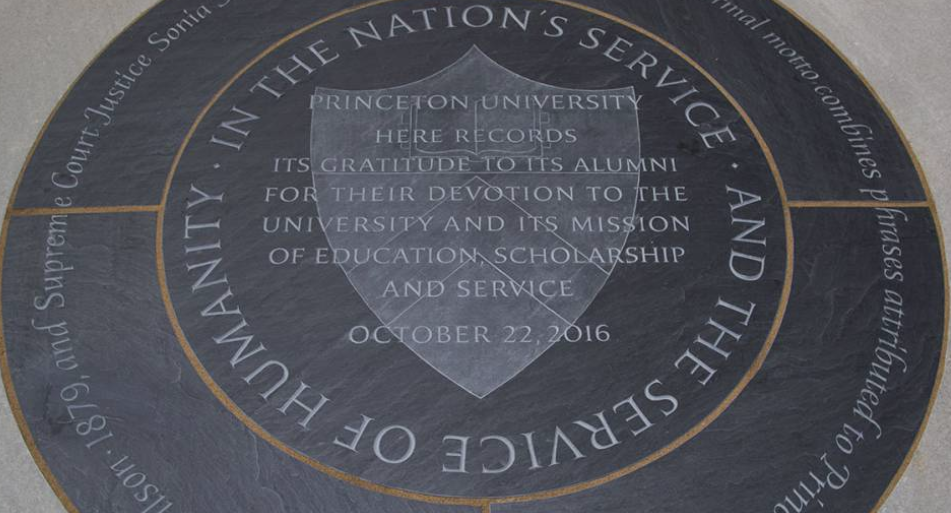
Take one example. In 2016, Princeton revised its informal motto to "In the Nation's Service and the Service of Humanity." The words are now carved on the stone medallion on the walkway in front of Nassau Hall, and the university describes service as "central to the mission of Princeton." Princeton repeats this commitment across its public-facing pages, which describe helping students and alumni use their educations to benefit society as well as themselves.
Source: Princeton University, Photo by Danielle Capparella, Office of Communications.
Harvard's Center for Public Service and Engaged Scholarship expresses a similar idea. Harvard College aims to prepare students as "citizens and citizen-leaders for our society," equipped to serve with integrity, compassion, and a sense of responsibility for the well-being of others. It describes civic engagement and public service as integral to undergraduate life and to Harvard's mission. Like Princeton, Harvard presents service as an essential part of its educational philosophy and the kind of community it seeks to build.
Other highly selective universities also connect community engagement to their missions, values, and admissions. Stanford's admissions FAQ says that beyond academic achievement, it seeks "evidence of sustained commitment and leadership in school and community activities."
Rice considers students' "contributions to their communities within the context of their life experiences."
Duke's mission statement says the university seeks "students who make things better and treat others well."
Vanderbilt's mission names service to the community and society at large alongside research and teaching, and its dean of admissions says officers look for both the difference the student made to the organization and "the difference the organization made within the student."
These statements, which reflect the educational goals these institutions publicly claim to uphold, are common (dare I say universal?) among highly selective universities.
Highly selective universities are looking for
Students who have demonstrated genuine concern for others, contributed to their communities, and used their education in service of something beyond themselves.
Community service is one of the clearest ways applicants can provide evidence of those qualities.
What do admissions officers say in surveys?
Surveys of admissions officers reveal the same emphasis. In a survey conducted by IESD for x2VOL, 58% of admissions personnel agreed that a student's community service experience has a positive impact on their likelihood of admission (cited in Derek Newton's Forbes coverage).
The reasons colleges gave are particularly interesting. Admissions officers view service as evidence that a student is likely to be active in student life outside the classroom, is likely to contribute to the school's mission, and shares the school's values. More than two-thirds of the surveyed admissions officers agreed with these explanations.
Does Service Help?
58%Agreed25.5%Neutral/No Answer16.5%Disagreed
Source: IESD for x2VOL 2018
In other words, admissions officers value service among applicants because it provides evidence of the kind of community member a student may become on campus. Community service is a kind of proxy, a shorthand, for how likely the student is to contribute to campus life and use the opportunities and education they receive for something beyond personal advancement.
As their mission statements and survey responses make clear, highly selective universities see community service at the heart of what they do: preparing society's future leaders, global citizens who will make enormous contributions to the world. Community service links the core work of colleges and universities to higher purposes such as transformative learning, education for democracy, and research that improves the world (Harkavy and Hartley).
Why do universities care so much about service?
Because it sits at the core of their mission and describes the kind of people they hope to produce. Elite universities know that their graduates will become business leaders, physicians, policymakers, researchers, and thought leaders. They're looking for students who have already proven they can handle responsibility, have meaningfully engaged their communities, and have a sense of shared duty to address the problems our societies face.
If you're aspiring to an Ivy League-plus education, your community service needs to go beyond volunteer hours at random organizations for disparate causes with no clear connection.
Now we can return to the two scenarios at the start.
Student 1 has done valuable work and would receive credit for being conscientious and generous with his time. But his record, as presented, is mostly a collection of worthwhile activities and accumulated volunteer hours.
Student 2's experience tells a more complete, compelling story. She remained involved over time, assumed greater responsibility, reflected on what she encountered, and allowed her experiences to reshape her academic interests and future plans.
Student 1 could still tell an equally compelling story. Perhaps assisting with the blood drive deepened his interest in public health, access to care, or the responsibilities of medical professionals, and prompted new questions. Those connections may already exist, but admissions officers cannot infer them without explicit comment. The student has to identify, reflect on, and communicate them.
So, yes, community service matters for college admissions. It matters when it provides evidence that a student is already using their time, energy, education, and opportunities to address a social issue and to contribute to something larger than themselves. That sits at the core of the mission of highly selective colleges and partially defines a successful applicant.
How many community service hours do colleges want?
There is no specific, magic number of hours that colleges require, and more hours of community service do not necessarily translate to a stronger application.
There is no magic number of community service hours. Admissions officers evaluate the quality of the experience: why you chose it, what you learned, and how it shaped your sense of responsibility to others.
Still, if your high school or school service club expects a number of hours before graduation, complete the requirements in good faith. Tracking hours has benefits. Hours are easy to record, verify, and compare, and they can be a useful benchmark that helps you feel you're making progress. Small wins, represented by accumulated service hours, build momentum.
When it comes to college admissions, however, hours are not the right framework. An hour total shows that a student participated. It says little about the quality of the experience. Instead of hours, colleges want to know:
• Why did the student choose this volunteer opportunity?
• What was meaningful about the service?
• What did the student learn from the experience?
• How did the experience shape their sense of responsibility to others?
The hours framework can also shift attention away from the purpose of service itself. High school students are used to being evaluated through easily measurable achievements such as grades and test scores, so it is understandable that they approach community service the same way. But that obscures what many selective colleges say they actually value: genuine collaboration with others, contribution to the common good, and growth through the experience.
This perception can lead students and families to try to game the system of community service, treating it as another achievement to accumulate and display. That creates three problems:
1. It encourages cynical, extrinsically motivated behavior that treats community service, and implicitly the people it's designed to benefit, as means rather than ends.
2. It limits the opportunity to develop empathy for others, stronger ethical awareness, and an understanding of yourself as part of a larger community.
3. It stunts the very qualities admissions officers are looking for: authenticity, honesty, and a genuine expression of the student's voice.
Ultimately, service hours are by-products of a deeper transformation. Community service is at its best when it makes a meaningful contribution and changes how you see yourself. What colleges are after is young people who see themselves as contributors to their community, whatever the hour total. Strong applications weave service into a coherent narrative linked, ideally, to the student's academic interests and long-term goals.
Even that expectation must be applied in context. Students do not have equal access to money, transportation, family and institutional support, or influential networks. A meaningful contribution for one student may look very different from a meaningful contribution for another. That's why universities apply what I call the opportunities and privileges principle.
How do colleges account for opportunities and privileges?
Admissions officers evaluate what you did in reference to the opportunities actually available to you, not against a single universal standard. Holding every applicant to the same bar would be unfair, and colleges say so directly.
Here's another story of two students. One attends a well-resourced private school that offers school-sponsored community service days and organized service trips, with parents who have contacts among philanthropists and nonprofit leaders.
Another attends a school with few organized service opportunities, has no comparable family network, works 15 to 20 hours a week, and cares for younger siblings. Would it be fair to hold these two students to the same standard?
How much can reasonably be expected of you depends in part on how much you have been given: the resources, opportunities, and networks you have access to. A student with extensive resources and free time may reasonably be expected to have done more with those opportunities than a student balancing school with work and major family responsibilities.
The philosopher John Rawls offers a useful way to understand why. In his famous "veil of ignorance" thought experiment, Rawls asks us to imagine designing a just and fair society without knowing what family we would be born into, how wealthy we would be, or what advantages and disadvantages we would inherit by accident of birth. Take a moment to think about it. How would you design society if you didn't know where you would end up? You would probably resist rules that reward people simply for advantages they never earned. Unearned advantages are called privileges.
College admissions works according to this opportunities and privileges principle, at least in theory. Admissions officers do not evaluate activities and accomplishments in a vacuum. They take the student's context into account.
Admissions officers try to distinguish between what a student was given and what that student chose to do with it. They ask: what opportunities and privileges did this student have, and how fully did they use them?
R.J. Hernández-Díaz, PhD
Senior Strategy Consultant
Alternatively, you can think of this as the "to whom much is given, much will be expected" principle (Luke 12:48). If you're familiar with the parable of the talents, you know where this comes from. Like the servants in the parable, you may reasonably be expected to have made meaningful use of the opportunities available to you, for your own advancement and in contribution to others.
Again, don't take my word for it. Colleges explicitly say they evaluate applicants in context.
Rice's application philosophy page says the university evaluates each student "within the context of their school and personal environment," considering both the opportunities they had access to and the challenges they faced.
Yale states the principle even more directly: no applicant is disadvantaged for not using a resource that was never available to them, because Yale seeks students "who have made the most of their individual circumstances."
The system isn't perfect, but colleges do have ways to verify opportunities. The National Center for Education Statistics reports that 71% of public high schools organize community service events for their students, and access varies. Schools serving lower-income students are less likely to have organized community service programs than schools with a more affluent student body. That is an important reason admissions officers don't simply compare hours across applicants. Context sets the standard.
The Common Application school report also asks counselors whether their school requires volunteer service. That means admissions offices may know when an applicant's hours were mandatory rather than freely chosen. You won't be penalized for completing required service hours, but meeting the same requirement as every classmate won't make you stand out either.
Required service still counts, especially when you go the extra mile to reflect on your actions and make them part of your story. In that case, required volunteering can become a meaningful admissions boost.
Elite universities expect people of tremendous privilege and extensive opportunities to have made meaningful use of them, including in service to others. There's no need for this to be a burden; it can become part of your own education and growth. Serving others can make you feel alive. It changes you, and more often than not it gives you an appetite to continue serving. As Gordon B. Hinckley put it: “One of the great ironies of life is this: He or she who serves almost always benefits more than the person who is served.”
"Everybody can be great," Martin Luther King, Jr. said, "because everybody can serve." Take advantage of your opportunities and do great things.
What do admissions officers look for in service activities?
No highly selective university publishes data showing that a particular type or amount of community service produces a measurable admissions boost. Instead, colleges disclose what they value: contribution to community, initiative, sound judgment, commitment over time, and making the most of the opportunities available to you.
Devery D., a former admissions officer now at Crimson, puts the underlying principle plainly.
Selective universities aren't just looking for smart students. They seek individuals who will positively contribute to their community.
Devery D.
Former Harvard Admissions Officer
From those explicit values and that underlying principle, we can distill four elements of good community service activities.
Commitment
Choose an issue that you care about and that you can devote yourself to for months and years.
Issue selection comes first. That's why we recommend doing some preliminary social analysis research, as well as some exploratory volunteering, before committing yourself to a particular cause or issue. Note that this differs from random volunteering. It's intentional, self-driven, and, if you do it right, reflective. Think of it as trying to discover a problem that you want to understand and where you can contribute in a meaningful way.
Growth
Show progressive involvement from participant to leader to advocate for future directions.
Think of it this way: you don't start as a basketball or soccer team captain. First, you have to learn the game, develop your skills, figure out how to contribute to the team as a whole, and earn the trust of your teammates. Leadership comes after you have demonstrated commitment and learned how to bring out the best in others.
Community service develops the same way. Begin by participating and listening. Study the issues. Help to solve an unglamorous problem that an organization or group actually has. Over time, become someone the community can depend on. Then, as your knowledge and responsibilities grow, you may be ready to lead others, help determine where the effort should go next, or advocate for broader change.
Collaboration
Approach service as a collaboration rather than an act of charity.
Rachel Naomi Remen distinguishes between helping, fixing, and serving. Helping can unintentionally reinforce inequality by positioning one person as strong and another as weak. Fixing assumes a community is broken and that you have the solution. Serving, by contrast, begins with the recognition that every community has its own dignity, strengths, and expertise.
Highly selective universities have embraced serving as distinct from helping or fixing. Harvard's public service programs stress reciprocity, respect, and allowing community voices to guide the work.
Johns Hopkins takes a similar approach, building mutually beneficial partnerships in which communities help co-design projects and define priorities. JHU's admissions office likewise looks for students who have contributed meaningfully to their schools and communities side by side with community partners, learning from them as well as serving them.
The message is clear: the strongest service is something you do with a community, not just for it. Admissions officers are likely to read this mindset as resonance with their own philosophy of community service and as evidence of maturity and humility.
Reflection
Reflect on how your service experiences have influenced your future aspirations, especially in your college essays and elsewhere on your application.
It often makes sense for your community service to relate in some way to your intended major or career goals. That said, there's no need to pretend every act of service confirms a career plan formed at age fourteen. Explain authentic connections where they exist.
The relationship does not need to be direct. A service experience may raise a question you later explore academically, challenge an assumption you once held, help you acquire a skill, or cause you to reconsider what kind of work you hope to do. In some cases, service confirms an existing interest. In others, it complicates or redirects it. The goal is to show that your experiences have shaped how you think about your education, your responsibilities, and the kind of contribution you hope to make.
Taken together, admissions officers are looking for a story: why you committed to this issue, how your contribution and responsibilities developed over time, how you collaborated with the community, and what you learned from the people and problems you encountered.
That does not mean every student needs a dramatic transformation story or a perfectly coherent connection between service and intended major. It does mean the work should become more meaningful as you become more involved. By the time your application is submitted, admissions officers should be able to see what you did, why it mattered, whom it served, how you changed, and what kind of member of a college community you are likely to become.
Common community service mistakes
The most common mistake comes from assuming that admissions officers evaluate service the way they might evaluate an awards list: the bigger, rarer, and more prestigious, the better.
That assumption pushes students toward activities designed to signal achievement rather than meet actual community needs. The admissions guidance from selective colleges suggests almost the opposite: substance matters more than status, and a contributor who takes responsibility for a particular issue can be far more compelling than the nominal founder of an organization that accomplishes little.
For example, college advice blogs and Q&A sites frequently imply that founding a nonprofit beats joining one. Selective colleges do not say this. Harvard explicitly values the nature of a student's contribution, meaning what the student actually did, whom they helped, and how much responsibility they assumed, rather than the sometimes misleading titles attached to student activities lists.
Do you need to found a nonprofit?
No. Admissions officers do not expect every applicant to have founded an organization or solved a major social problem, but they are looking for initiative. Join an established organization first and learn from people who have been working on the issue long before you arrived. Start something new only when there is a genuine unmet need. Facing complex social problems is hard enough; going it alone makes it harder.
Harvard Graduate School of Education's 2016 report Turning the Tide captured this disconnect between student perception and college messaging, and it set the tone for what many admissions offices practice today. We can organize its findings in a table comparing what students think colleges want in community service and what these schools actually look for.
What students think elite colleges want vs. what elite colleges say they value
What students think colleges want
What elite colleges say they value
Short, high-profile, or exotic service projects, often in a distant place with little personal meaning, that appear to demonstrate entrepreneurial spirit and leadership
Sustained involvement lasting months and preferably a year or more, where students are immersed in an experience and develop emotional and ethical skills
Individual service that maximizes personal impact or brand, especially through a leadership title or a newly founded organization
A useful contribution, with or without a title, especially collaborative action with communities on real local problems
Helping a passive group of "disadvantaged" people
Engagement with people of different economic, social, racial, and religious-cultural backgrounds
Formal nonprofit or NGO volunteering only
Work, caregiving, family responsibilities, and local contributions all count
Service designed primarily to demonstrate achievement, ambition, or admissions strategy
Service that develops gratitude, concern for others, and a sense of responsibility for the future
Two notes on the table. Evidence that newly founded student organizations address real community concerns remains dubious, which is part of why titles carry so little weight on their own. And the diversity point is not incidental: engagement across economic, social, racial, and religious-cultural lines is itself part of what colleges consider valuable about service.
The best kind of service is sustained, collaborative, and transformative, in the sense that it changes the applicant as well as the community they work with. Here's the same guidance reformulated as a list of don'ts and do's.
Don'ts and do's of community service
Don't
Do
Choose an activity only because it looks convenient or easy
Choose an issue you care enough about to pursue over time, and consider where your effort can make an outsized impact. Not all issues are alike
Arrive with a prepackaged solution, or cast yourself as the savior of a passive community before understanding the problem
Listen to community members and learn about the issues. See yourself as a collaborator and co-worker in the larger work
Found an organization just to claim a leadership title, or try to solve complex social problems alone
Join an established organization first and learn from people who have been thinking about and struggling with these issues long before you arrived. Start something new only when there is a genuine unmet need
Present your work as an effortless, straight-line trajectory (student notices problem, acts, transforms lives)
Explain obstacles, mistaken assumptions, and failures, and what changed as a result. Real community work usually involves failure and ambiguity
Inflate or exaggerate participation or impact numbers
Keep honest records and report concrete, verifiable evidence of results. Credible evidence separates real work from resume-padding wishful thinking
What counts as community service?
Does paid work or family responsibility count?
Absolutely. Paid work undertaken to support the family, and other substantial family responsibilities, count as community service.
Supporting an elderly neighbor, translating for new immigrants, mentoring younger students, helping at a religious or cultural organization, working to support your household, or improving a neglected part of your school community may all count as service. For more specific examples, take a look at our list of 100 community service ideas.
At Crimson, our students have done some amazing community service work. Broadly, it falls into five categories.
Environment & climate
Sustainability projects, climate action, and conservation work in local communities.
Equity & policy advocacy
Gender equity campaigns, legal rights education, and policy advocacy.
Health & disability
Disability inclusion, neurodiversity awareness, and health advocacy.
Education & access
Tutoring, mentoring, and building access to learning for underserved students.
Animal welfare & relief
Animal welfare, humanitarian relief, and community infrastructure projects.
Does this mean the best community service necessarily falls into one of these categories? Not at all. If you're looking to do some service, ask yourself: where is there a real need, what do I care enough about to stay involved with, and how can I become genuinely useful over time?
Does religious service count?
Yes. One of the most unfortunate tendencies I've seen is for students to downplay their religious service work, even when it represents a significant commitment, say 2 to 3 hours a week for most weeks of the year.
Colleges do not generally restrict meaningful extracurricular involvement or community service to secular organizations. UChicago, for example, tells applicants to include "whatever it is that you spend your time doing outside of class," whether that is an official organization, a job, or a family responsibility.
Religious service should not be treated as somehow less legitimate simply because it takes place in a church, synagogue, mosque, temple, or other faith community. Volunteering to set up and break down a worship space, regularly playing in a band or singing in a choir, teaching younger children, organizing community events, and helping at a faith-affiliated food pantry can all be meaningful contributions.
As with any other activity, what matters is the substance of the commitment: how much time you devoted to it, what responsibilities you assumed, whom you served, how your role developed, and what you learned from the experience.
How to make your service meaningful: act, reflect, act again
Community service is not a departure from the more serious tasks of academic preparation or extracurricular activity. At its best, it informs and gives direction to those other tasks. When done well, community service can distinguish an otherwise highly qualified applicant at top colleges.
Highly selective colleges are on a mission to educate changemakers: people at the forefront of their fields who are dedicated to doing their work for the betterment of their family, community, society, and ultimately humanity. They want young people who have already demonstrated some level of commitment to a cause, a measure of responsibility and care, and a willingness to cooperate with people whose experiences may be very different from their own. As Admiral Hyman G. Rickover observed, one person alone cannot do the job, but one person can make a difference.
A long list of disconnected activities serving unrelated causes is therefore unlikely to be especially persuasive on its own. Your community engagement should become part of a larger story about what you value, your curiosity, your developing skills, and the kind of contribution you hope to make.
That means taking action to serve others, reflecting on what matters to you and why, and using those insights to take more action. It's a virtuous cycle: act, reflect, choose, and act again. You serve, notice what you do not understand, ask better questions, learn from the people around you, and then return to the work with greater knowledge and responsibility. Over time, your actions shape your values, and your values shape your next actions.
“Education must extend beyond the intellectual to include not only socially responsible attitudes but also thoughtful and appropriate action.” Source: International School at Dundee.
That is ultimately the kind of transformation colleges hope to see. Community service done well becomes part of how you learn who you are, what you owe to others, and what you might do with the opportunities an education gives you. Act, reflect, and act again, and you will become the kind of applicant highly selective admissions officers are looking for.