University Insights Last Updated:
Columbia University Acceptance Rate for the Class of 2030
Columbia Admits 4.23% Of Applicants To Class of 2030

Arkesh P.
Chief Operating Officer at Crimson
Summary
Columbia University has released the application volume data for the Class of 2030. Columbia College and the School of Engineering and Applied Science (SEAS) received 61,031 applications, the largest applicant pool in the university's history, and a 2.4% increase from the 59,616 applications received for the Class of 2029. Out of those, the university accepted 2,581 students, for an overall acceptance rate of 4.23%.
Columbia University admitted 2,581 students to the Class of 2030 at an overall acceptance rate of 4.23%, releasing results on Ivy Day, March 26, 2026, when all eight Ivy League schools simultaneously notified Regular Decision applicants of their decisions. Columbia College and the School of Engineering and Applied Science received 61,031 applications, the largest applicant pool in Columbia's history.
That figure continues a years-long trend of intense competition for places at one of the world's most selective universities. For context, the Class of 2029 saw Columbia admit an initial 2,557 students from 59,616 applicants at 4.29%, later expanding to 2,946 after waitlist admissions, as the university enrolled its largest-ever incoming class of 1,806 first-year students.
A rate below 4.5% from a record applicant pool tells its own story about Columbia's trajectory. The more interesting question is what separates the applications that succeed from the thousands that don't.
Columbia University Acceptance Rate for the Class of 2030
| Class of 2030 | Class of 2029 |
Total Applications | 61,031 | 59,616 |
Total Admitted | 2,581 | 2,557 |
Overall Acceptance Rate | 4.23% | 4.29% |
The Class of 2029 figures have an important nuance worth understanding when comparing cycles. Columbia's initial Ivy Day release for the Class of 2029 reported 2,557 admits at 4.29%, later growing to 2,946 after waitlist admissions as the university enrolled its largest-ever incoming class of 1,806 students. The Class of 2030 initial figure of 4.23% from a record 61,031 applicants represents a slight dip from the Class of 2029's initial rate and a more dramatic drop from its final figure. The Class of 2030 class will be approximately 175 students smaller than the Class of 2029, reflecting Columbia's phased enrollment expansion plan of adding 125, 200, then 250 students to the next three incoming classes.
Early Decision applications for the Class of 2030 fell 6.4%, from 5,872 to 5,497. That decline almost certainly reflects the broader context surrounding Columbia this cycle, federal funding controversy, a high-profile settlement with the Trump administration, and shifting national perceptions, rather than any fundamental change in the university's appeal. That the overall application pool still grew to a record 61,031 suggests demand for Columbia remains strong.
Columbia also remains the only Ivy League school that has not reinstated mandatory standardized testing. Every other Ivy has returned to test-required admissions, making Columbia's test-optional stance a structural differentiator for the Class of 2030.
Should You Apply Early Decision to Columbia?
Columbia offers one Early Decision round and it’s binding. Applying Early Decision means committing to enroll if admitted, a decision that should only be made when Columbia is a clear first choice and the financial implications are fully understood upfront.
With that context in place, the data makes a strong case for applying early.
| Class of 2030 | Class of 2029 | Class of 2028 |
ED Applications | 5,497 | 5,872 | 6,007 |
ED Admitted | ~687* | ~758* | ~801* |
ED Acceptance Rate | ~12.5%* | ~12.9%* | 13.3%* |
Figures are Crimson Education estimates. Columbia does not release ED admitted figures or acceptance rates. Estimates are derived from total admitted figures and historical data.
A few things stand out in the data:
— Columbia stopped releasing ED and RD breakdowns from the Class of 2028 admissions cycle onward. Based on Crimson Education estimates, ED acceptance rates have ranged between approximately 12.5% and 13.3% across the past three cycles, consistently offering applicants roughly three times the overall acceptance rate.
— ED applications have trended downward over two consecutive cycles, from 6,007 for Class of 2028 to 5,872 for Class of 2029 to 5,497 for Class of 2030. A smaller, more self-selected ED pool has historically correlated with a stronger overall pool, which may influence how the rate moves.
— For students applying to impacted majors, computer science, economics, biology, the case for applying early is especially strong. Early Decision functions partly as yield tools and admissions officers reading ED files can be assured that applicants are truly committed. That changes the tone of the read in ways that matter.
For students who are certain Columbia is their first choice and whose application is ready by November 1, applying early remains the strongest strategic move.
If you're deferred from ED and Columbia remains your first choice, write a focused Letter of Continued Interest (LOCI) that reaffirms your commitment and highlights any significant new developments since you applied. Keep it short. Admissions officers read a lot of these, and the ones that succeed get straight to the point.
Columbia Regular Decision Acceptance Rate
At Columbia, Regular Decision is where the vast majority of applicants find out their fate, competing for the places that remain after Early Decision.
| Class of 2030 | Class of 2029 | Class of 2028 |
RD Applications | ~55,534* | ~53,744 | ~54,241 |
RD Admitted | ~1,894* | ~1,799* | ~1,524* |
RD Acceptance Rate | ~3.4%* | ~3.4%* | ~2.8%* |
Figures are Crimson Education estimates. Columbia does not release RD figures.
Regular Decision at Columbia is where the full weight of the competition becomes clear. With roughly 55,000 RD applicants competing for an estimated 1,894 places, our internal estimates put the Class of 2030 RD acceptance rate at approximately 3.4%, consistent with the previous cycle and among the most selective of any Ivy League school.
Dean of Undergraduate Admissions Jessica Marinaccio captured what the committee was looking for across the cycle: “My colleagues and I have felt deeply inspired by the enthusiasm, curiosity, dedication and intellectual spirit that students shared with us through their applications.” That framing, curiosity and intellectual spirit above all else, tells you something important about what Columbia actually seeks, and it shapes how every application in the pool is read.
Class | Applications | Admitted | Overall Rate | RD Rate | ED Rate |
2030 | 61,031 | 2,581 | 4.23% | ~3.4%* | ~12.5%* |
2029 | 59,616 | 2,946 | 4.29% | ~3.4%* | ~12.9%* |
2028 | 60,248 | 2,325 | 3.86% | 2.8%* | 13.3%* |
2027 | 57,129 | 2,246 | 3.93% | 2.7% | 14.6% |
2026 | 60,377 | 2,253 | 3.73% | 2.7% | 12.5% |
2025 | 60,551 | 2,355 | 3.89% | 2.9% | 11.9% |
ED and RD figures for Classes of 2028, 2029, and 2030 are internal estimates. Columbia stopped releasing ED and RD breakdowns from Class of 2028 onward.
A few things the historical data makes clear:
Application volumes have plateaued
— Columbia's applicant pool has hovered around 57,000 to 61,000 for five consecutive cycles
— Unlike peer institutions that saw dramatic surges during the test-optional era, Columbia's volumes have been relatively stable
— The Class of 2030 ED decline suggests some moderation in overall volumes may follow
Overall rates have fluctuated more than peers
— Columbia's overall rate moved from 3.7% to 4.9% between the Class of 2026 and Class of 2029
— That movement reflects Columbia's unusual Class of 2029 expansion rather than a fundamental easing of competition
— The RD rate, which is the more consistent indicator, has remained in the 2.7% to 3.4% range
ED advantage has remained consistent
— ED rates have ranged between 11.9% and 14.6% across four verified cycles
— That consistent advantage makes Early Decision a significant strategic consideration for committed applicants
What Columbia's Acceptance Rate Actually Means for Applicants
Columbia is the only Ivy League university with a required Core Curriculum. Every undergraduate, regardless of major, works through the same foundational texts in philosophy, literature, art, music, and science. That single fact defines what Columbia is looking for, and it should define how every applicant approaches their application.
The final question asked about every file in committee was simple: do they love Columbia? Not strong grades, not an impressive activity list but does this student really see themselves in this specific academic community? In practice, that's where most applications fall short.
The academic baseline is non-negotiable. Not submitting a score isn't held against you, but among students who did submit for the Class of 2029, the middle 50% SAT range was 1460 to 1530, with an ACT equivalent of 33 to 34. If you do submit, the score needs to be strong. Scores that don't strengthen your file are better left off.
Three things matter above almost everything else:
Nerdy, specific passion that connects to Columbia's mission: Columbia loves granular intellectual passion. The more specific a student gets about what they care about and why, the more compelling the application becomes. A student working at the intersection of biology and ethics, who can articulate why that kind of thinking connects to their intended path, is showing exactly the kind of mind Columbia is building its class around. For this student, the Core isn't a burden. It's exactly what they want. And if a student applying to Columbia College doesn't mention the Core at all, that absence is noticed.
An inspired case for admission, not a request for one: The admissions officer's job is to advocate for a student in committee, and that advocacy is only possible if the application gives them the material to build a case. If the word Columbia could be replaced with Harvard or Princeton without changing the meaning, the essays aren't doing their job. Columbia even has specific internal language for applicants whose stated major doesn't match their activity list. A student whose essays point one way while their activities point another is flagged as, for example, an art history applicant who is clearly a lurking English major. It gets spotted immediately, every time.
New York City as a resource, not a backdrop: Students who can speak specifically to how they plan to engage with the city stand out. Whether it's the publishing industry, finance, the nonprofit sector, the arts scene, or the policy landscape, New York is part of the Columbia education in a way that is unlike any other Ivy League campus. Showing you've thought concretely about how you'll use it is one of the most distinctive things a Columbia applicant can do.
Crimson Capstone Projects in Action
The following Crimson students admitted to Columbia built the kind of record the university actually admits: work pursued with purpose, impact felt within a community, and a timeline that started long before any application deadline.
Literary Justice and Poetry Education Initiative
— Founded a literary justice organization focused on poetry as a tool for personal expression, healing, and community building
— Created a copyrighted curriculum, trained 30 instructors, and built 13 chapters across multiple locations
Led 8 international workshops and 4 open-mic events, teaching over 250 students directly
— Developed a specialized outreach program responding to incarcerated writers through poetry correspondence
— Received local news coverage
— Admitted to Columbia among offers from Princeton, Penn, and Northwestern
Music and Mental Health Interview Series
— Identified the intersection of musical expression and mental wellbeing as an under-explored area and built a platform to explore it
— Conducted and edited interviews with musicians and psychologists on mental health, developing a structured methodology combining performing arts and psychological perspectives
— Published articles and hosted collaborations, scaling the initiative to reach 60,000 students across 30 countries
— Admitted to Columbia among offers from Johns Hopkins and UNC Chapel Hill
Independent Software Development and Education Technology Projects
— Developed and sold a Python-based golf tee-time automation bot generating over $3,000 in revenue
— Built an AI-powered learning application for a local academy, collaborating directly with the institution to refine and implement the tool
— Created a website and social media presence for a local antique business, extending its reach to new customers
— Demonstrated the ability to identify real-world problems, build technical solutions, and bring them to market, exactly the engineering for humanity mindset Columbia's SEAS program looks for
— Admitted to Columbia
These aren't students who just assembled impressive résumés. One built a movement for literary justice that reached inside prison walls. Another created a platform that connected music and mental health across thirty countries. A third turned technical skills into real products that served real people. That's the profile Columbia is looking for, and it shows in every part of their applications.
How Crimson Can Help
Columbia rewards students who've built a focused, specific story around intellectual passion, change-maker ambition, and a clear vision for how they'll use everything the university and New York City have to offer. It isn't a process that responds well to last-minute preparation.
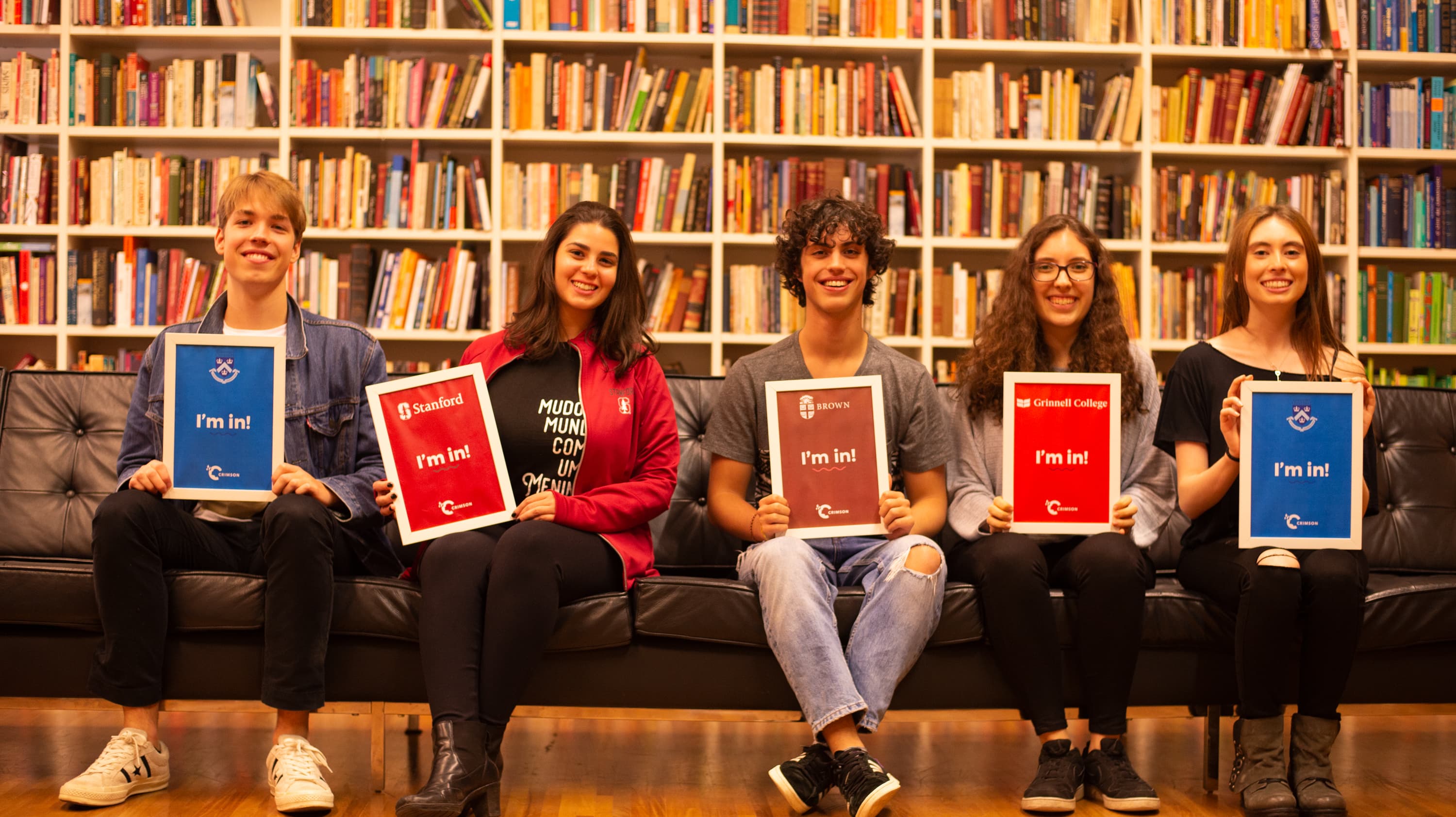
This cycle, Crimson students achieved 42 offers of admission from Columbia, against a general acceptance rate of 4.23%. Results like these aren't accidental. They're the product of a personalized, data-driven strategy built around each student's specific strengths, interests, and ambitions, and one that can begin well before high school even starts.
Each student is supported by a team that can include admissions strategists, essay mentors, research and capstone supervisors, SAT tutors, and subject specialists, all working from the same tailored roadmap.
If Columbia is on your list, the best time to start building the kind of application that gets noticed was yesterday. The next best time is now. Schedule a free consultation with a Crimson expert today.