
From Cupertino Vision to Columbia Reality
How Crimson’s Strategic Mentorship Forged Derek's Path to the Ivy League
Derek Q.
Accepted to
Columbia University
A Silicon Valley Talent Seeking Direction
The Starting Point
Accepted to
Columbia University
Target Field
Economics-Political Science
Academics
- 3.94 / 4.0 Unweighted GPA
- 36 ACT
- 5 AP scores
Activities
- Political Activism
- Community Service
- Debate / Forensics
Location
California, USA
Future Plans
Policymaker/Government
From Cupertino Vision to Columbia Reality
How Crimson’s Strategic Mentorship Forged Derek's Path to the Ivy League
Derek Q.
Accepted to
Columbia University
Target Field
Economics-Political Science
Academics
- 3.94 / 4.0 Unweighted GPA
- 36 ACT
- 5 AP scores
Activities
- Political Activism
- Community Service
- Debate / Forensics
Location
California, USA
Future Plans
Policymaker/Government
A Silicon Valley Talent Seeking Direction
The Starting Point
The Solution
Finding His True Voice
Crimson’s approach isn’t to reshape students, but to help them uncover and express their genuine interests. From early in the process, Derek worked closely with his mentor, Jordan to explore a passion for economics and political science. Together, they developed a unique personal angle—a profile that combined data-driven thinking with real-world impact. By understanding what admissions officers are truly looking for, the student was able to present themselves as an intellectually curious and socially engaged future leader.
“The biggest turning point was guiding Derek to choose activities not just for his own interests, but to strategically strengthen his college applications”
How Crimson Helped
Weaving The Winning Narrative
At Crimson, we provide end-to-end support—combining strategic coaching, hands-on labs, and targeted follow-up tactics. For Derek, that meant alumni-led interview training to perfect his delivery and a custom-crafted Letter of Continued Interest (LOCI) after his Columbia deferral, ensuring his renewed passion and new achievements shone through.
Academics at a Glance
Crimson helped Derek target his coursework and prep toward Economics-Political Science—guiding his AP choices and ACT strategy to deliver a 36 ACT score and five 5-score AP exams that perfectly underscored his academic passions. With the right programs presented in a polished application that caught his dream school’s eye
5
Calculus AB
5
United States History
5
Biology
5
English Lit & Composition
4
Chemistry
5
Economics: Microeconomics
European History
Computer Science A
Spanish & Culture
Extracurriculars Amplified
Derek had the grades but needed a plan. With Crimson’s help, Derek transformed his passion into impact—scaling EduGrant into a statewide nonprofit through Cal-SOAP partnerships and public seminars, securing policy-focused roles as a legislative intern and advisory board member, and showcasing his leadership as captain of the #1 national debate team.
Top Highlights
Crimson coached Derek on pitching ideas and networking with professors, leading to two published projects: a USC collaboration with Prof. Juan Gonzalez on state tax policy (featured in the Scholarly Review Online Showcase) and an Oberlin-accredited study with Emory’s Prof. Jong Kim on public debt in developing nations.
Ranked #5 Nationally NSDA US Policy Debate
Top-32 NYU Int’l Public Policy Debate Tournament
CA Legislative Recognition of Distinguished Service
Profile Transformation
From “Wonky Activist” to “Social Thought-leader”
Crimson Education's comprehensive and personalized support system transformed Derek from a student with strong potential but unclear direction into a focused, compelling applicant who knew how to articulate his unique strengths and passions.
Before
After
Academically strong, interested in humanities and debate, but "lacked direction"
Profile & Narrative
Academically strong, interested in humanities and debate, but "lacked direction"
Crafted a clear, authentic social activist narrative and mastered how to pitch his profile to elite schools
General interest in top schools; limited knowledge of specific institutional values.
Strategy & School Fit
General interest in top schools; limited knowledge of specific institutional values.
Targeted application to Columbia, plus customized strategies for other top schools.
Initial ideas lacked connection to personal growth and university fit.
Essays
Initial ideas lacked connection to personal growth and university fit.
Crafted a personal statement showing personal growth to nail the “Why Columbia” story.
Involved in debate and local volunteering.
Extracurriculars
Involved in debate and local volunteering.
Scaled extracurriculars—founded statewide nonprofit EduGrant, secured legislative internships, and led the #1 national debate team.
Academically strong, interested in humanities and debate, but "lacked direction"
Research Experience
Academically strong, interested in humanities and debate, but "lacked direction"
Completed two mentored research projects on economic inequality and public policy.
“I was ecstatic—my entire family was around me... and that opportunity was incredibly, incredibly happy... I felt like a gigantic burden was lifted off my shoulders and that I was dreaming.”
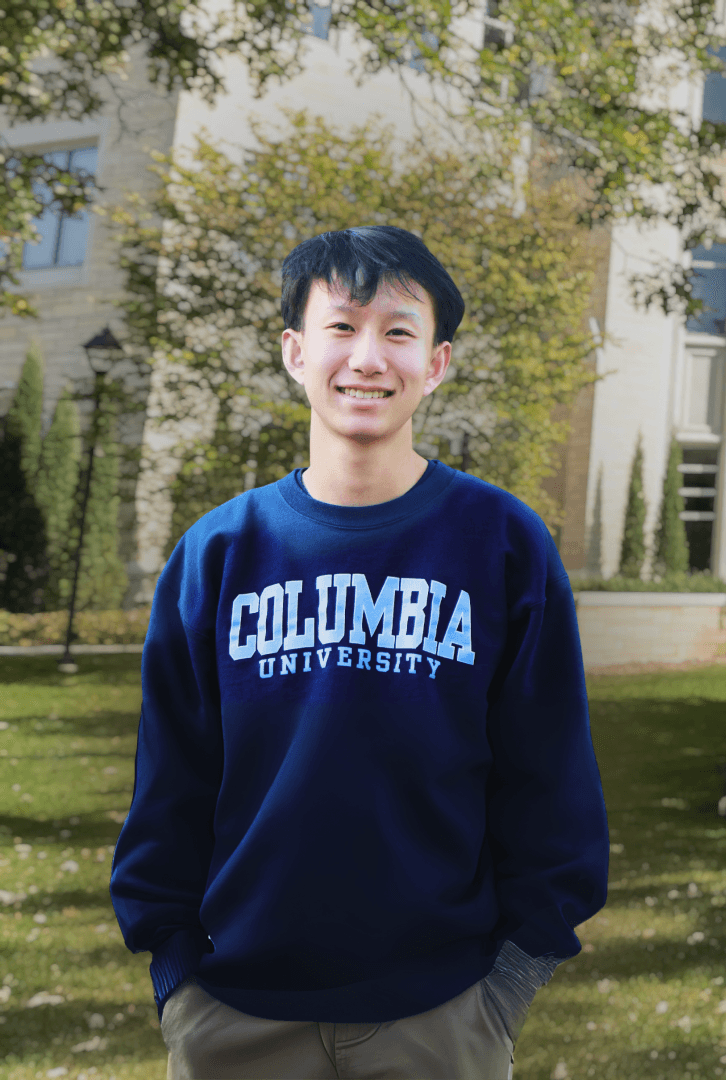
Derek was accepted to Columbia University to study Economics-Political Science. He was initially deferred and then accepted on Ivy Day.
Results
How Derek Won Columbia’s Heart
Columbia saw in Derek exactly what they look for in their best students - genuine political passion backed by real action.
01
Strong Essay
His essays didn’t just mention activism—they showed it through his work with local politicians and the financial aid nonprofit he built from the ground up.
02
Showcasing Personality
With his Crimson strategist, Derek highlighted both sides of himself: a policy wonk diving into economic research, and a community organizer helping real people on the ground.
03
Right-fit for Columbia
His application showed a genuine alignment with Columbia—from the Core Curriculum’s intellectual rigor to its pulse at the center of social movements.
Behind The Scenes
In Conversation with Derek
I grew up in Cupertino, California, in the middle of the Bay Area. Growing up in an area that was almost inundated with technological innovation, I was just as surprised as my parents about my interest in the humanities. In high school, I found the most joy in literature classes, and researching public policy for my school's debate team. At a Jesuit high school, I also spent a lot of time volunteering and working with the underprivileged.
I chose Columbia as my dream and school to ED to. Out of all the top schools, it was the university that I thought aligned best with my passion for politics and activism, as I saw a spirit of activism there that was unique and powerful. I'll be majoring in Economics-Political Science there, balancing theoretical ideas with concrete application in the heart of New York City. I was incredibly compelled by its Core Curriculum, covering literature and art from across the ages.
I first heard about it from my parents, who were recommended it by a family friend. I decided to work with Crimson because I felt I lacked direction in the college application process, and sought greater clarity in how I could improve my chances of getting into my dream school. I didn't have a lot of knowledge on the process compared to my friends, and wanted to learn more and be able to reach my potential.
I worked with Crimson for two years, starting at the beginning of my junior year. We started out identifying what major and profile I wanted to fit into, as well as identifying what ECs would supplement that story. Over the course of the two years, Crimson helped me identify tons of different opportunities to immerse myself in politics, as well as to grow projects that I started on my own. They helped me formulate ideas for a capstone project that fit into my interests, grow it to a state-wide level, and how to translate such action into the application itself. They also supported me in my research, in deciding what subject to look into and how to reach out to professors.
My strategist Jordan probably had the largest impact on my application. He attended Columbia himself, and provided invaluable insight on both how to write essays but also structure my application. Meeting him my junior year, he helped me choose what major I wanted to apply in, and gave me a litany of different avenues to pursue to find activities that fit that… In terms of essays and the application itself, he helped me write activity descriptions for all my activities, and how to word them correctly to have the largest impact on a prospective Admission Officer. I also had help along the way from EC coaches who helped me grow my passion project, teaching me how to reach out to other organizations with similar mission statements, as well as leveraging government resources to grow my non-profit organization aimed at improving the financial aid access to underprivileged communities.
I think that the most valuable part in working with Crimson was the insight I was given into how the admission process worked. Going into my junior year, I kind of saw college admissions as a black box, where people often got into random places without a lot of explanation as to why. In conversations and meetings with my strategist Jordan, I learned a ton more about how admission officers make the decisions they do, whether it is to expand the intellectual vitality of their institution or to look for a balanced class. In the application itself, I learned to research and try to pitch myself more as the exact type of student each college actually wants, and learned to delineate between schools that seemingly have similar mission statements. Getting to chat with Jordan about what type of student different universities want was incredibly useful in crafting a successful application for so many of these schools.
I think the biggest lesson I learned during the application process was to trust in the time I had put into my application the last four years of my high school career. Oftentimes when writing essays, I stressed an unnecessary amount about minute grammatical or syntactical changes, and lost sight of the bigger picture, and all the work that I had put in the last four years, to achieve a perfect GPA, great standardized testing scores, and compelling extracurriculars that would weigh far more heavily on the results of my application than one or two commas in an essay. I think that's also what I'm most proud of - the continued commitment that I showed in my four years in high school, studying hard even when there wasn't a clear end in sight and choosing to pursue activities that I loved.
I can see myself on two paths. The first is pursuing economics fully, like a job in finance like investment banking or consulting in the heart of New York City. On the other hand, I might also choose to go the route of pre-law, and I might see myself testing to try to get into law school 5 years from now (or maybe even already in law school). In that case, I might also take a gap year before the LSAT, perhaps looking for employment somewhere in New York in finance in the interim. It's still all a little bit up in the air.
I think the most pertinent piece of advice that I got was to pitch the correct application to the school. I think that my profile fits Columbia incredibly well, as they are a school that historically prides themselves on the political passion in their student body. Different schools have different students they are looking for, and being able to identify that through research, and adapt to it is something that helped me tremendously get into other prestigious universities.
