A high school resume helps admissions officers quickly understand a student’s story, priorities, and impact beyond what fits into standard application boxes. It is often the only place where leadership progression, long-term commitment, technical skills, and side projects can be clearly structured and interpreted at a glance.
As Crimson strategist Shane puts it: admissions officers use resumes to see “the things that can’t fit cleanly into the Common App activities list,” especially continuity, leadership, and real-world impact across years.
For students applying to competitive universities, internships, scholarships, or enrichment programs, a resume is not optional preparation. It is strategic groundwork.
Why a Resume Matters Even in High School
A strong resume shapes first impressions under time constraints
In academic and professional settings, resumes are frequently reviewed before essays, interviews, or recommendations. Admissions officers often spend seconds, not minutes, deciding where to focus their attention.
A clear resume allows them to quickly answer:
- What does this student invest time in?
- Is there progression, or just participation?
- Where is the strongest evidence of impact?
When admissions officers are reading hundreds of applications per week, structure and hierarchy matter as much as substance.
How Admissions Officers Actually Use Resumes
Admissions officers do not use resumes to re-read an activities list. They use them to understand what is missing elsewhere.
According to our Consultants, resumes are scanned for:
- Leadership progression across years
- Evidence of sustained commitment
- Impact beyond titles
- Technical or specialized skills
- Independent or side projects
- Volunteer work with continuity
As Shane explains, a resume helps admissions officers “see your story at a glance” when the rest of the application is fragmented.
Admissions officers check résumés for the stuff that doesn’t fit in your Activities list;
Leadership progression, impact scale, and continuity across years.
It’s also the best place for you to make sure colleges get a clear view of your technical skills, volunteering, or side projects.
– Shane O'Donoghue
Writing a Resume Early Improves Long-Term Outcomes
Maintaining a resume in high school is less about immediate use and more about skill development.
Students who start early:
- Learn how to articulate impact clearly
- Track achievements accurately over time
- Identify gaps in depth or focus
- Avoid reconstructing years of activity later
By senior year, resume writing becomes refinement rather than recovery.
When High School Students Actually Need a Resume
High school students commonly need resumes for:
- Part-time or summer jobs
- Internships and research roles
- Pre-college academic programs
- Scholarships and fellowships
- Selective volunteer opportunities
- Academic competitions
- Certain college applications or supplements
Even when a resume is optional, having one prepared allows students to respond quickly when opportunities arise.
When a Resume is Worth Preparing
A high school resume is worth preparing if you are doing any of the following in the next 12–24 months:
- Applying for internships, research roles, or part-time jobs
- Submitting scholarship or fellowship applications
- Applying to selective pre-college or enrichment programs
- Reaching out directly to professors, labs, startups, or organisations
- Preparing for competitive college admissions where context and depth matter
Even if a resume is never formally submitted, maintaining one helps students track progression, clarify priorities, and avoid scrambling when opportunities appear unexpectedly.
How Colleges Use High School Resumes
Optional Does Not Mean Ignored
Many colleges do not require resumes. When students submit one anyway, it is still reviewed, but relevance matters more than volume.
Admissions officers generally prefer:
- One page
- Clean, conventional formatting
- No repetition of the activities list
- Emphasis on leadership, impact, and progression
A resume strengthens an application when it clarifies priorities rather than expands indiscriminately.
Accuracy and Cross-Checking
Ensure you are being precise and accurate in your resume as any claim can be verified through:
- Counselors
- Recommenders
- Program records
- Interviews
Precision and accuracy matter. Overstatement is more damaging than omission.
What to Include in a High School Resume
Core Sections That Matter
Most effective high school resumes include:
- Name and professional email
- Education and academic context
- Key extracurricular activities
- Work, internship, or volunteer experience
- Leadership roles
- Awards and honors
- Skills, especially technical or specialized ones
Addresses and phone numbers are optional in most modern contexts.
When to Include
Notes
Name + Email
Always
Use a professional email address
Education
Always
Include school, graduation year, and academic context
Extracurriculars
Always
Prioritise depth and progression over volume
Work / Internships
If applicable
Paid and unpaid roles both matter
Leadership Roles
If applicable
Show growth and responsibility over time
Awards & Honors
If applicable
Prioritise selective or externally validated awards
Skills
Situational
Especially valuable for technical, research, or creative fields
Projects
Situational
Strong differentiator when clearly explained
What Students Often Undervalue
After reviewing hundreds of applications, our consultants frequently see our students underuse resumes for:
- Independent projects
- Long-term volunteering
- Technical skills learned outside school
- Research, startups, or creative work
- Roles that evolved significantly over time
These elements often differentiate top applicants when presented clearly.
How to Write Bullet Points That Work
Use Strong Action Verbs and Outcomes
Effective bullet points:
- Start with strong action verbs
- Focus on outcomes rather than duties
- Include scale or results where possible
Examples
-Led a four-person team to raise $1,600 for music equipment
-Built and maintained a website used by 300+ users
-Conducted original research under a university mentor
Through reviewing all our applications we found that generic phrasing signals low engagement while specific phrasing signals ownership which is what admissions officers want to see.
Persuaded Set Goals Stimulated Studied Taught
Trained
Quantify Where You Can
Numbers anchor credibility and help admission officers quickly understand scope. Even small metrics provide clarity.
Formatting Rules That Matter to Admission Officers
Keep It Skimmable
Admissions readers scan quickly. Formatting should support that reality:
- One page whenever possible
- Clear section headers
- Consistent font and spacing
- Reverse chronological order
- Bullet points rather than paragraphs
We highly recommend that your design should never compete with content.
File Naming and Version Control
Best practices include:
- PDF format
- File named with your full name
- One “standard” version plus tailored versions
- Organized folder structure with dates or keywords
This reduces mistakes under deadline pressure.
Using Resume Templates Strategically
Templates can:
- Save time
- Improve visual clarity
- Reduce formatting errors
But they can also:
- Limit customization
- Create formatting issues
- Obscure important information
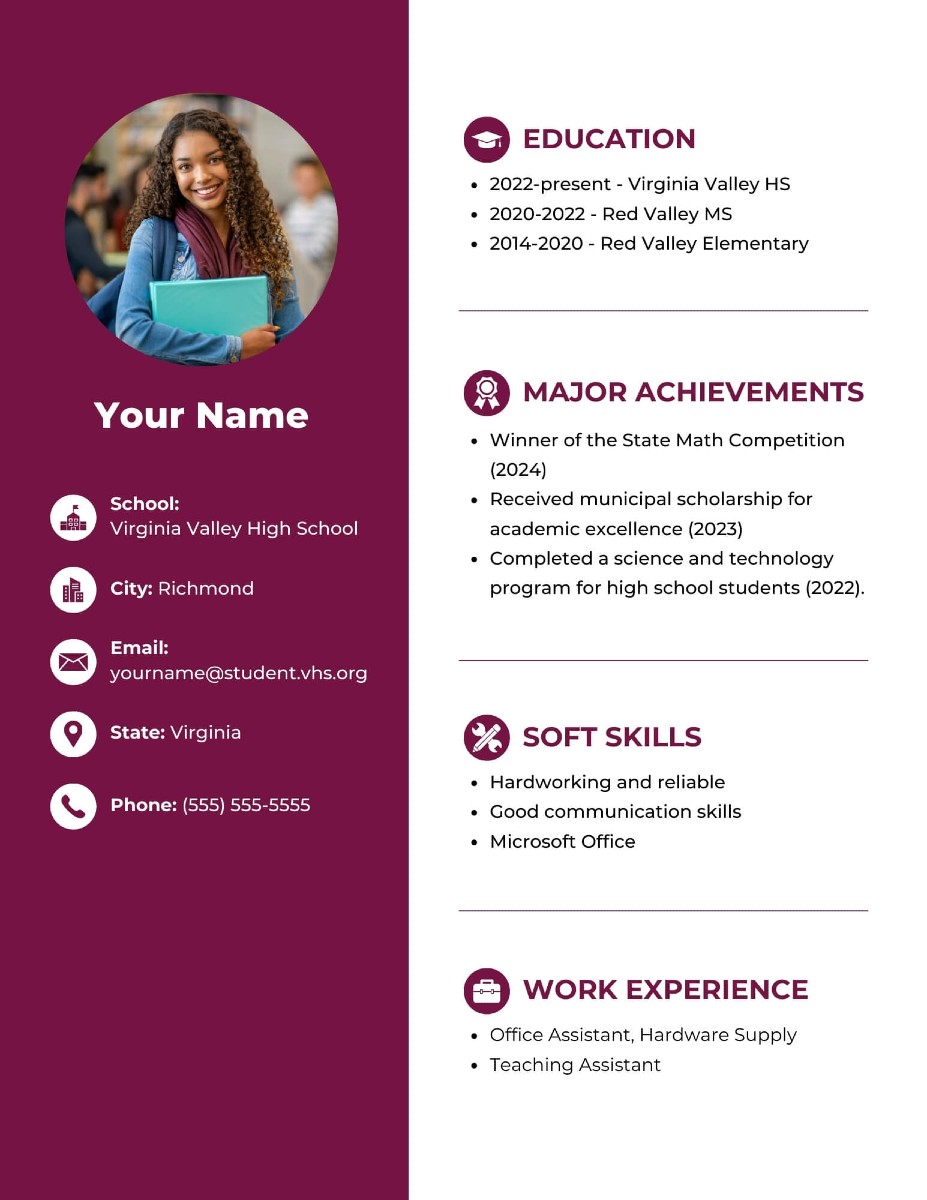
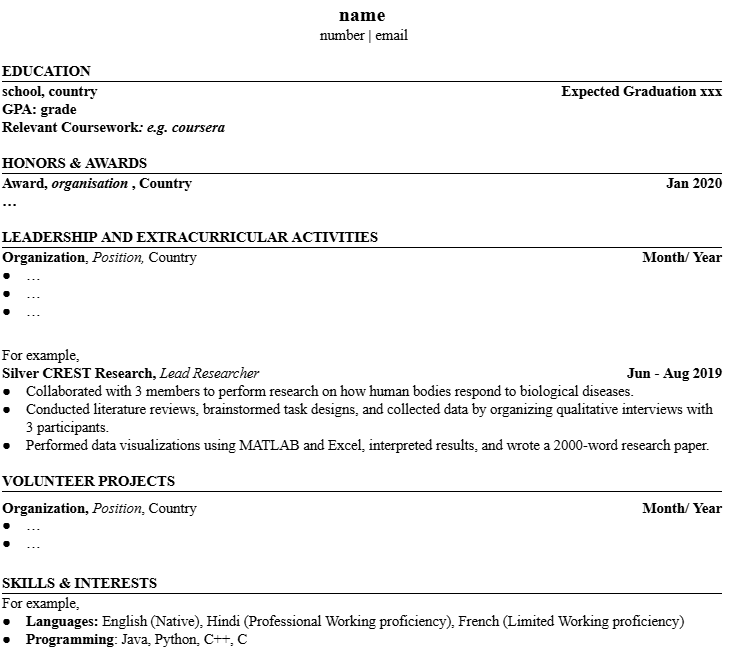
We recommend to use templates as a starting point rather than a constraint. Below is a template you can use to help you get started.
Updating and Tailoring Your Resume
Treat Your Resume as a Living Document
Every new role, award, or skill should be added while details are fresh. This avoids reconstruction later.
How to Tailor Without Distorting
- When applying to specific opportunities:
- Reorder sections by relevance
- Adjust wording to mirror program language
- Highlight aligned skills and experiences
Ensure that when you're tailoring your resume you focus on emphasise key points rather than exaggerating them as Admissions officers can tell the difference.
Do High School Students Need Cover Letters?
Short answer: cover letters are not universally required, but they do matter for internships, part-time jobs, selective programs, and any opportunity where motivation and fit influence selection.
A resume shows what you’ve done. A cover letter explains why you are applying and why this opportunity makes sense for you.
When a Cover Letter Is Worth Writing
Cover letters are most useful when:
- Applying for internships or part-time jobs
- Applying to competitive programs or fellowships
- Submitting applications that explicitly request one
- Reaching out directly to an organization or individual
They are less relevant for standard college applications unless explicitly requested.
When a Cover Letter Adds Value
A cover letter adds the most value when:
- The application explicitly requests one
- You are applying for internships or part-time jobs
- You are applying to competitive programs or fellowships
- You are reaching out directly to an organisation, lab, or individual
Note: Cover letters are rarely useful for standard college applications unless specifically required.
What Admissions Officers and Recruiters Look For
Cover letters are not evaluated like essays. Admissions officers skim them quickly to answer a few specific questions like:
- Does this student understand the role or program?
- Is there a clear reason they are applying?
- Does their interest align with their resume?
Strong cover letters complement the resume rather than repeat it. They reference experiences selectively and frame them in context.
How to Write a Strong High School Cover Letter
According to our team of consultants, effective cover letters:
- Are concise, usually three to four short paragraphs
- Focus on interest, fit, and motivation
- Reference resume experiences without duplicating them
- Use clear, professional language
A good rule of thumb
If the resume shows your qualifications, the cover letter explains your intent.
Cover letter Example
Dear Ms Lim,
Application for position of Management Associate
I am a Life Science graduate of the National University of Singapore, and I am writing to apply for the position of a Management Associate in ABC Healthcare. I recently attended the campus recruitment talk by ABC and had the opportunity to speak to Mr John Tan, the H.R. Manager. He shared with me many insights on the role of Management Associates, which intrigued me. I have also read that ABC is expanding its joint venture with XYZ Medi
What to Avoid in your Cover Letters
Cover letters lose impact when they:
- Restate the resume line by line
- Sound generic or templated
- Overstate achievements
- Exceed one page
Clarity and alignment matter more than length. Admissions officers and recruiters can quickly tell when a letter is thoughtful versus performative.
Final Thoughts
A high school resume is not just a formality or a checklist item. It is a strategic document that shapes how admissions officers, recruiters, and program directors interpret a student’s journey when time and attention are limited.
The strongest resumes do not try to include everything. They prioritise clarity, progression, and impact. They show how a student’s interests developed over time, where responsibility increased, and what outcomes were achieved. When done well, a resume makes the rest of the application easier to understand rather than harder to navigate.
Whether you are applying for internships, scholarships, enrichment programs, or competitive universities, maintaining a clear and accurate resume early gives you an advantage. It reduces last-minute stress, sharpens how you articulate your experiences, and ensures that when an opportunity appears, you are ready to act.
A resume does not replace essays, recommendations, or interviews. It anchors them. And in a competitive admissions landscape, that foundation matters more than most students realise.
Interested in navigating Ivy League Admissions? Book a free consultation with one of our expert consultants to understand how your resume, activities, and academic strategy work together in a competitive admissions landscape.